Summary:
You want your backyard to feel like yours again. Maybe the neighbors are too close, the kids need a safe space to run, or the pool area just needs some separation from the rest of the world. Whatever the reason, a wood fence keeps coming back as the answer — and it’s not hard to see why.
Wood is warm, versatile, and genuinely beautiful in a way that vinyl and aluminum can’t quite replicate. But if you’ve lived in Central Florida for any length of time, you already know the climate doesn’t go easy on anything. Before you commit, it’s worth understanding what makes a wood fence work here — and what makes one fail.
Wood Fence Styles That Work in Central Florida's Climate
One of the biggest surprises for first-time fence buyers is how much design variety wood actually offers. Most people picture one thing when they hear “wood fence,” but the options go far beyond a standard picket line.
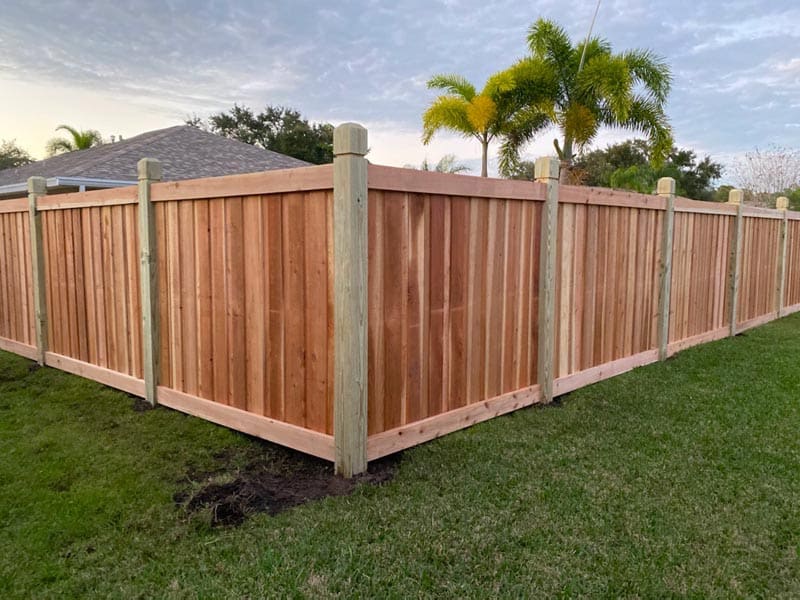
Board-on-board is probably the most popular choice for privacy across Central Florida. Boards are mounted on alternating sides of the rail, which means you get full coverage even as the wood naturally expands and contracts with our region’s humidity — a real advantage in a climate where thermal movement is constant. Shadowbox fencing works similarly and gives the fence a cleaner, more symmetrical look from both sides.
Horizontal plank fencing has grown significantly in popularity across communities like Winter Garden, Windermere, and the newer subdivisions in Osceola County. It reads as more modern and pairs well with contemporary home architecture. Dog-ear picket styles remain a classic for front yards and decorative boundaries, while custom heights, stain colors, and cap styles let you match the fence to the character of your property.

Cedar vs. Pressure-Treated Pine: Which Wood Holds Up Better in Central Florida's Humidity?
This is the question we hear most often, and the honest answer is that both can perform well — but they perform differently, and the right choice depends on your priorities.
Pressure-treated pine is the most widely used wood for residential fencing in Central Florida. The treatment process forces preservatives deep into the wood fibers, giving it strong resistance to rot, moisture, and the subterranean termites that are endemic to this region. A properly installed pressure-treated fence, maintained with stain or sealant, can last 15 to 20 years in Central Florida’s climate. It’s also more budget-friendly upfront, which makes it a practical choice for larger properties or longer fence runs across places like Clermont, St. Cloud, or the acreage lots common in Marion County.
Cedar takes a different approach. Its natural oils act as a built-in defense against moisture, insects, and decay — no chemical treatment required. That same oil content gives cedar a rich, warm tone that many homeowners find more visually appealing than treated pine, especially when a clear or semi-transparent stain is applied. Cedar tends to resist warping and cracking better in high-humidity environments, which matters in a region where summer afternoons bring daily thunderstorms and the air rarely dries out completely.
The cost difference between the two is often smaller than buyers expect, particularly when you factor in long-term maintenance. Cedar may require slightly less frequent staining to stay in good shape, which can offset the higher material cost over time. What we’d caution against is untreated wood of any species — in Central Florida’s climate, untreated wood typically fails within five years. Whatever species you choose, treatment and proper finishing are non-negotiable here.
If you’re in a lakefront community in Lake County or a neighborhood with strict HOA aesthetic guidelines, cedar’s natural appearance often makes the decision easy. If you’re working with a larger footprint and budget is a primary concern, quality pressure-treated pine installed correctly will serve you well for decades.
How a Wood Privacy Fence Changes How You Use Your Backyard
Central Florida’s outdoor living culture is real. Pools, screened lanais, outdoor kitchens, weekend cookouts that stretch into the evening — the backyard isn’t just a patch of grass here, it’s an extension of the home. A wood privacy fence makes all of that better.
The most immediate change is the obvious one: you stop feeling like you’re on display. Dense suburban neighborhoods in places like Oviedo, Longwood, and the Dr. Phillips corridor don’t give you much natural separation from neighboring properties. A six-foot board-on-board fence changes that entirely. You can let the kids play, let the dog run, or sit by the pool without thinking about who’s watching.
But the benefits go beyond privacy. A well-built wood fence defines your space in a way that landscaping alone can’t. It creates a clear boundary, adds structure to the yard, and gives the whole property a more finished, intentional look. That translates directly to home value — research from the National Association of Realtors suggests that a quality fence installation can return between 50 and 70 percent of its cost in added resale value, with privacy fences tending to perform better than decorative-only options.
There’s also the security angle. Families with young children or pets feel it immediately — the fence becomes a perimeter that keeps what matters to you inside and keeps unwanted visitors out. In communities near busy roads or adjacent to commercial areas, that peace of mind is worth something that doesn’t show up in any ROI calculation.
Wood fencing also gives you a canvas that other materials don’t. You can stain it to complement your home’s exterior, add lattice panels for climbing plants, or go with a custom height that fits your specific property. That kind of flexibility is hard to find anywhere else.
Wood Fence Maintenance in Central Florida's Climate
Here’s where people sometimes get the wrong idea. Wood fencing in Central Florida does require maintenance — but the actual commitment is more manageable than most buyers expect going in.
The short version: clean the fence once a year and reapply stain or sealant every two to three years. That’s it. One afternoon of work annually, and a half-day project every few years. In return, you protect a significant investment and keep the fence looking the way it did when it was first installed.
What happens when you skip it is where the problems start. Central Florida’s UV exposure bleaches and degrades unprotected wood faster than almost any other climate in the country. Daily summer rain, combined with the region’s year-round humidity, creates the conditions where mold and mildew take hold quickly. Termite pressure in Central Florida is among the highest in the United States — Formosan termites, in particular, are aggressive and widespread across Orange, Seminole, and Lake counties.
When Should You Stain or Seal a New Wood Fence in Florida?
Timing matters more than most people realize, and it’s one of the things that separates a fence that holds up from one that starts showing wear within a few years.
A new pressure-treated wood fence needs time to dry out before you apply any stain or sealant. The treatment process saturates the wood with moisture, and if you apply a finish before the wood has fully dried, the product won’t penetrate properly — it sits on the surface, peels early, and leaves the wood underneath unprotected. The standard recommendation is to wait three to six months after installation before staining. If you install in the fall or early winter, you’ll typically be ready to stain by spring — which also happens to be the ideal time of year for the application itself, before the rainy season begins.
When you do stain, product selection matters. In Central Florida’s climate, you want a stain that includes UV inhibitors to slow the bleaching effect of our region’s intense sun, and one that’s formulated to resist mold and mildew. A semi-transparent stain lets the wood grain show through while still providing meaningful protection. A solid stain offers more coverage and more protection but hides the natural character of the wood — it’s a trade-off that comes down to personal preference.
One thing worth knowing: a new pressure-treated fence will often look blotchy or uneven in the first few months as the wood dries and settles. That’s normal. The wood is still releasing moisture unevenly, and the color will even out as it dries. Don’t let the appearance of a new fence in its first few weeks concern you — it’s not a reflection of the installation quality.
For cedar fences, the timeline is a bit more forgiving. Cedar dries faster than pressure-treated pine, and its natural oils provide some baseline protection while you wait. But staining is still worth doing — it significantly extends the fence’s lifespan and keeps the color from going gray, which happens quickly in Central Florida’s sun.
Do Wood Fences in Central Florida Need Permits, and How Does the HOA Process Work?
These two questions come up constantly, and they’re worth addressing directly because the answers affect your timeline and your planning.
On permits: in most Central Florida counties, yes — a permit is required for residential fence installation. Orange County requires fence permits to be submitted online through their Fast Track system. Lake County, Seminole County, Osceola County, and individual municipalities like Sanford, Kissimmee, and Clermont each have their own requirements, and they’re not all the same. We manage the permitting process as part of every installation, so you don’t have to navigate county portals or figure out which forms apply to your specific address. What you do need to avoid is hiring an unlicensed installer who skips permitting entirely — that creates real problems when you go to sell the home and a title search turns up an unpermitted structure.
HOAs are a separate layer, and in Central Florida, they’re everywhere. A significant portion of the communities we serve across Lake, Orange, Seminole, and Osceola counties are HOA-governed, and many of those associations have specific rules about fence height, material, style, and placement. Florida law under Chapter 720.3035 requires HOAs to respond to architectural applications within 45 days — if they don’t, the request is considered approved by default. That’s useful to know, but it doesn’t mean you should skip the process.
What we recommend is getting your HOA’s architectural guidelines before you finalize your fence design. We’ve worked in communities across Central Florida long enough to know what most associations typically approve and what tends to get pushed back. If your community allows wood fencing, board-on-board and shadowbox styles are generally well-received because they look clean from both sides. Horizontal plank designs sometimes require additional approval in older communities with more traditional aesthetic standards. We can walk you through what to expect based on where you live and help you put together a design that’s likely to sail through the process without revision requests.
Choosing the Right Wood Fence Contractor in Central Florida
A wood fence is a long-term investment — one that should last 15 to 20 years when it’s built right. The material matters, the installation technique matters, and the contractor you choose matters more than most buyers realize until they’ve seen the difference firsthand.
Central Florida’s climate doesn’t forgive shortcuts. Posts set without proper concrete footings lean. Thin boards installed without the right spacing fail faster. Untreated or undertreated wood in this humidity doesn’t make it a decade. The gap between a fence that holds up and one that doesn’t often comes down to things you can’t see on the day of installation.
If you’re ready to move forward — or just want to understand what’s realistic for your property, your budget, and your neighborhood — we’re worth a conversation. We’ve been building fences across Central Florida since 2004, with roots in the industry going back to 1992, and we bring that experience to every project we take on.